The Resurrection of the Demon Realm
It’s that time of year again, Christmas 1989, and you’re standing in the video game aisle of a Toys “R” Us with your parents finding out what hot new games you’re going to add to your wishlist this year. In the glass cabinet ahead, the NES sits above aisles of carts, king of the consoles. But to your left, there is something new. Something black, sleek, and dangerous. It promises “High Definition Graphics” and “16-Bit Power.” It promises to do what Nintendon’t.
And right there is the most metal image you’ve ever seen emblazoned on a video game box. A fist pumping knight blasting a massive electrical storm out from his golden armor into the outstretched claws of an encroaching demon. Hell ya! It’s the weapon that would finally pierce Nintendo’s armor, Ghouls ‘n Ghosts. The quarter munching arcade nightmare by some miracle has shown up on the Genesis, making the NES instantly look like it should get brushed into the dustbin of history along with the Atari 2600 your parents used to own. It was a genius port and Sega’s beachhead into the console wars.

Genesis Does What Nintendon’t
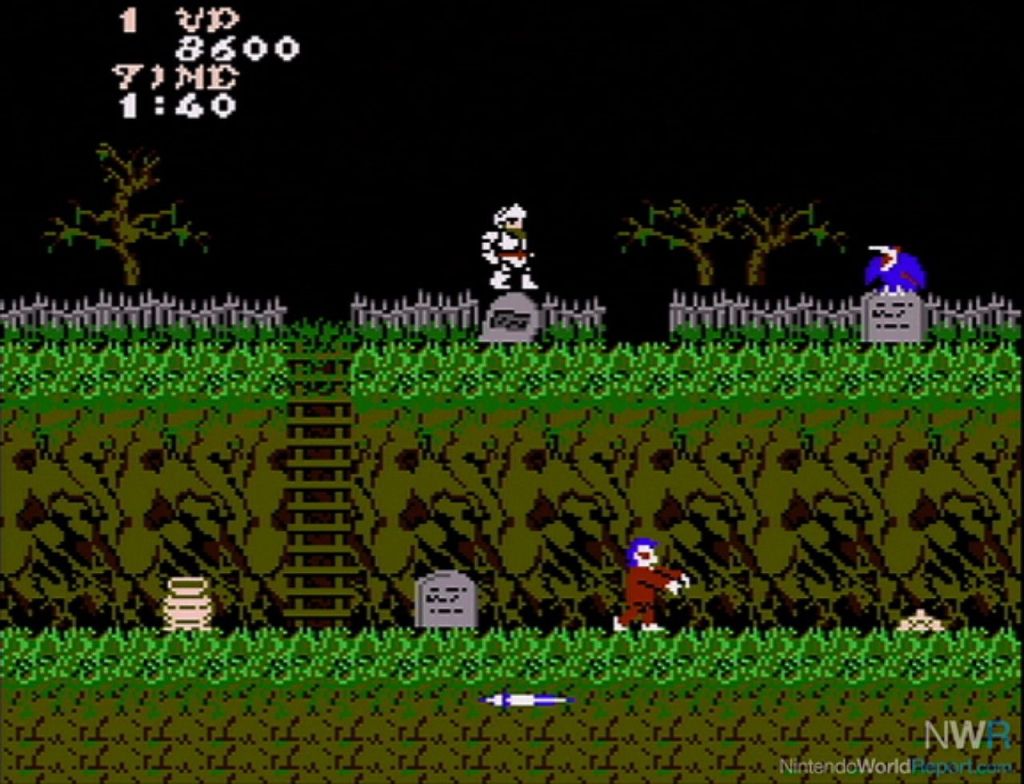
To understand why Ghouls ‘n Ghosts mattered, you have to remember the landscape of the late 80s. The gap between the arcade and the home console was massive. In the arcade, you had huge sprites, rich synthesized sound effects and quality visuals provided by advanced hardware. At home, on your NES, you had tiny sprites and repetitive soundtracks.
Enter Michael Katz, the new CEO of Sega of America. He walked into a market where Nintendo wasn’t just a competitor, they were the establishment. Katz knew he couldn’t beat Nintendo by playing their game. He had to change the rules. He adopted an aggressive, anti-establishment strategy centered on a simple, combative slogan: “Genesis does what Nintendon’t“.
The core of this strategy was his arcade at home mandate. The Genesis shared the same Motorola 68000 CPU architecture as many arcade boards, including Capcom’s CP System. This gave Sega a theoretical claim to arcade perfect ports, a holy grail for gamers of the era. But there was a problem. Nintendo’s licensing agreements were draconian. They often prevented third-party publishers like Capcom from manufacturing cartridges for competitor systems. Capcom couldn’t just release Ghouls ‘n Ghosts on Genesis without risking Nintendo’s wrath.
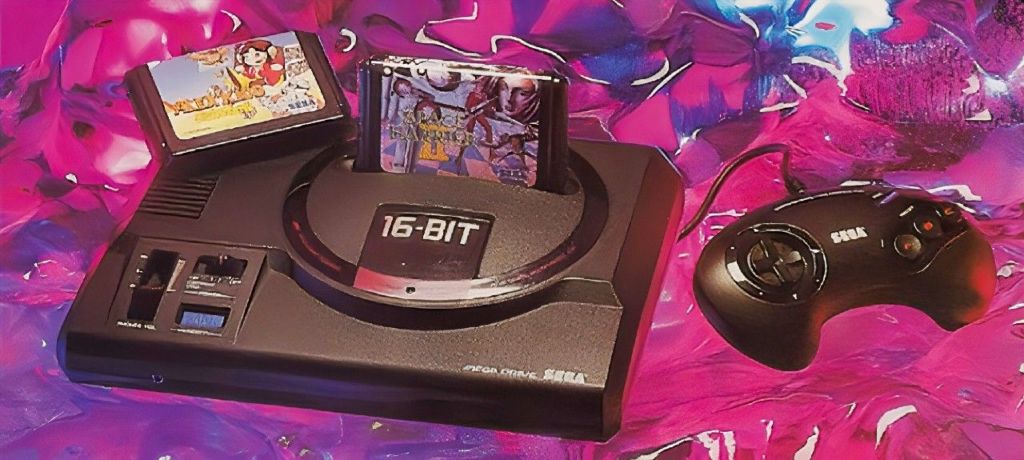
So, Sega pulled off a high-wire licensing act. They didn’t ask Capcom to publish the game. Instead, Sega paid for the right to use the Ghouls ‘n Ghosts trademark. In a rare move, they bought the raw source code and ROM data from Capcom. Sega then agreed to develop the port internally at Sega R&D. This loophole allowed Sega to get the ammunition it desperately needed to fight the console wars ahead. But the stakes were incredibly high. If this port failed, if it looked like a flickering, slow mess like ghost and goblins on the NES, the entire Genesis does what Nintendon’t campaign would be exposed as hype.
The Genesis of Sonic the Hedgehog
The task of converting this arcade behemoth fell to a young, obsessive programmer named Yuji Naka, the man who would later become a legend for creating Sonic the Hedgehog. But long before he was optimizing loop-de-loops, he was staring at a mathematical impossibility.

The original arcade version of Ghouls ‘n Ghosts ran on Capcom’s CPS-1 board, a powerhouse that supported 4096 colors and massive sprites. The game’s assets totaled vastly more data than the standard Genesis cartridge size, which was capped at a measly 4 Megabits. The program code for Ghouls ‘n Ghosts alone was bigger than 4 Mbit and most developers would have cut levels or shrunk sprites to make the rest of the game fit the strict cartridge limitations.
Naka refused and instead wrote custom algorithms to pack the graphics data into the cart, decompressing it on the fly during gameplay. But even that wasn’t enough and in a move that demonstrated his perfectionism, Naka famously pleaded with his bosses at Sega for just one more megabit. Sega acquiesced, manufacturing a unique 5-Megabit cartridge specifically for this game.
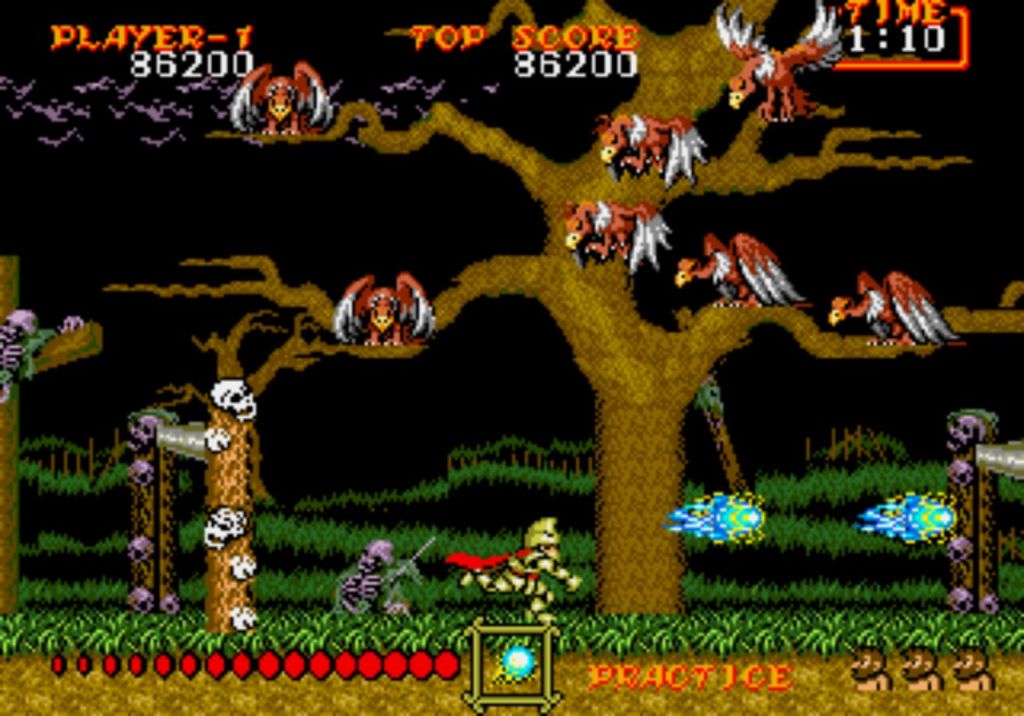
But Naka’s contribution went beyond mere compression. He was fascinated by a specific detail in the arcade game that would later come to define his career. The way Arthur walked up diagonal slopes was like nothing he’d programmed on the Master System. On the 8-bit consoles, terrain was usually flat or stepped blocks and the smooth, vector-like movement on an incline was a novelty that mesmerized Naka.
He spent weeks tweaking the physics variables of friction, gravity and momentum to replicate that trudging sensation perfectly. And this is where the seed was planted that would define the entire 16-bit generation. During these experiments Naka asked himself a very important question, what if a character moved so fast on a slope that they could run upside down?

The code routines Naka wrote to handle Arthur’s slow climb up the hills of the Demon Realm became the direct ancestors of the physics engine that powered Sonic’s movement through the Green Hill Zone. Without the challenge of porting Ghouls ‘n Ghosts, the physics logic for Sonic might never have been formalized. The fastest video game hero ever owed his existence to the slowest knight in history.
Professor F: The Originator of “Get Gud” Design
While Naka built the vessel, the soul of the game belonged to Tokuro Fujiwara. We worship Shigeru Miyamoto for his whimsy but, in Japan, Fujiwara was notorious for punishing video game players. He was the only person to scare resident evil creator Shinji Mikami. Mikami, who worked under Fujiwara, described him as a evil master with a scary aura. Fujiwara didn’t want you to beat his game, he wanted you to survive it. His goal was to create a lifetime game, a product with such profound difficulty that you could play it forever.

This wasn’t difficulty for the sake of cruelty. It was a calibrated mechanism to induce a fugue state within the player. Fujiwara believed that if the controls were responsive, the player would internalize their failures. When you died, and you would die thousands of times, you didn’t just blame the game you’d blame yourself. Part of what made the suffering bearable was the world Fujiwara created. The Demon Realm wasn’t just a generic fantasy dungeon, it was a carefully curated horror pastiche. The enemies aren’t just skeletons, they are pulsating masses of flesh, eyes, and bone.
However, Fujiwara knew that unadulterated horror could alienate players or feel like a cheap horror flick. To counteract this, he injected a distinct sense of the absurd. The horror is real, but so is the comedy.
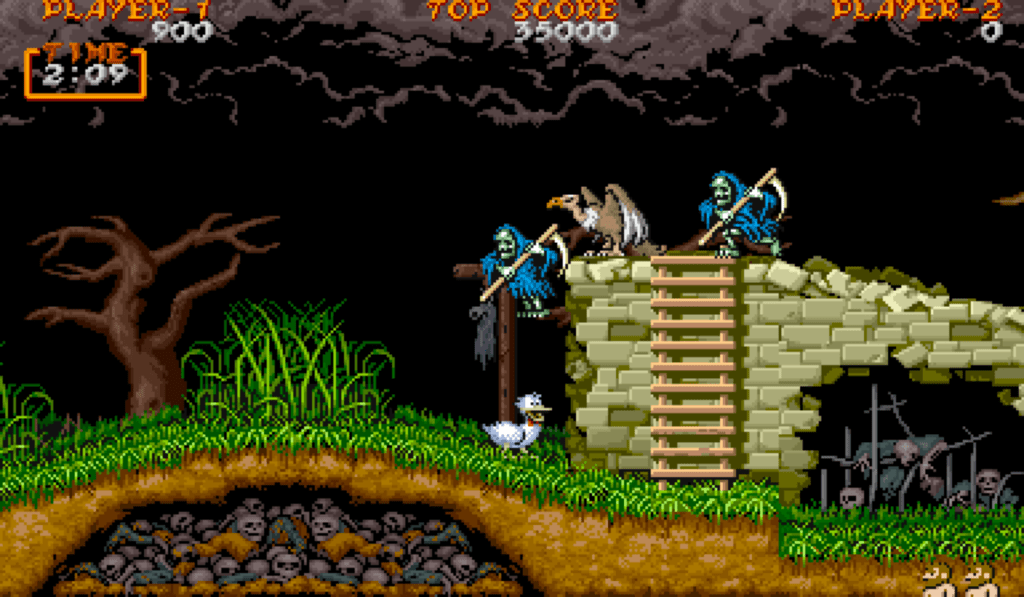
Consider Arthur, a stoic knight in shining armor. But take one hit, and he is stripped down to his polka-dot boxer shorts. The enemies, too, move with a bouncy, rhythmic quality that belies their lethality and the wizards that show up from time to time would turn Arthur into a duck or an old man. It instantly deflates the tension with slapstick humor injecting a bit of fun into an otherwise soul crushing experience, taking the edge off the player’s frustration.
Fujiwara’s philosophy culminated in the franchise’s most infamous mechanic of the Second Loop. You fight your way through five levels of hell and defeat the final boss, Astaroth. Your palms are sweaty, your heart is racing. And then? The game laughs at you. A message appears from the devil, mocking your efforts as an illusion.
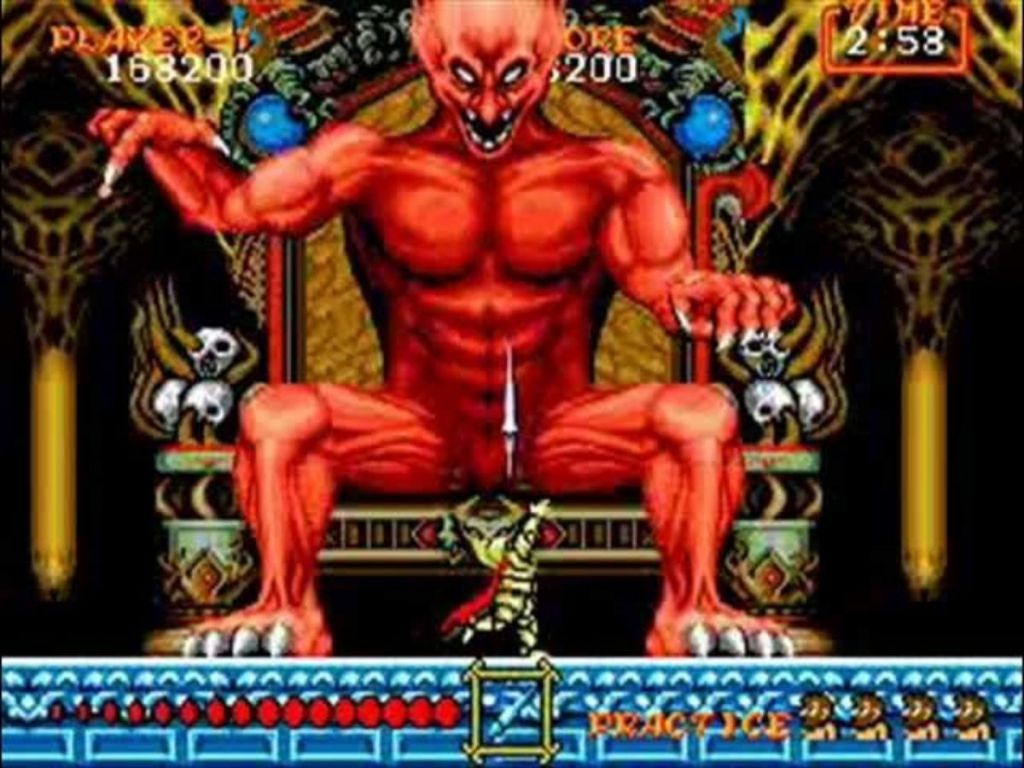
To see the true ending, you are forced to replay the entire game on a higher difficulty. It was a design choice that, in any other context, would have caused riots. But in Ghouls ‘n Ghosts, it cemented the game as the ultimate test of prowess. It was the Dark Souls of the 16-bit era.
The 16-Bit Christmas: How Arthur Slayed the NES
Now Sega had the vision, the code, and the design. But a game is nothing without a market and Christmas 1989 was the decisive moment Nintendo left an opening for Sega. The delay of the highly anticipated Super Mario Bros. 3 left the NES without a major new killer app to lead its holiday season and gamers were left looking for an entirely new experience from their favourite home console.

Into this void stepped the Sega Genesis, armed with Ghouls ‘n Ghosts. The contrast was brutal. NES owners were playing games with variable frame rates and limited palettes. Genesis owners were playing Ghouls ‘n Ghosts with its massive bosses, parallax scrolling rain storms and orchestral-quality music. It was the first tangible proof that the next generation had arrived. It validated Sega’s claim to arcade superiority and the hype could be felt throughout print media at the time.
Ghouls ‘n Ghosts was the killer app that carried the system through that first critical holiday season with 500,000 units sold. It bought Sega the time they needed to build the brand and, most importantly, time for Yuji Naka to take those slope physics he invented for Arthur and develop them for a blue hedgehog.
Defining the Generation
The release of Ghouls ‘n Ghosts was a watershed moment. It provided visual evidence that the Genesis was superior to the NES, serving as the cornerstone of Michael Katz’s marketing assault on Nintendo. It validated the 16-bit hardware race, proving that a home console could finally approximate the arcade experience.
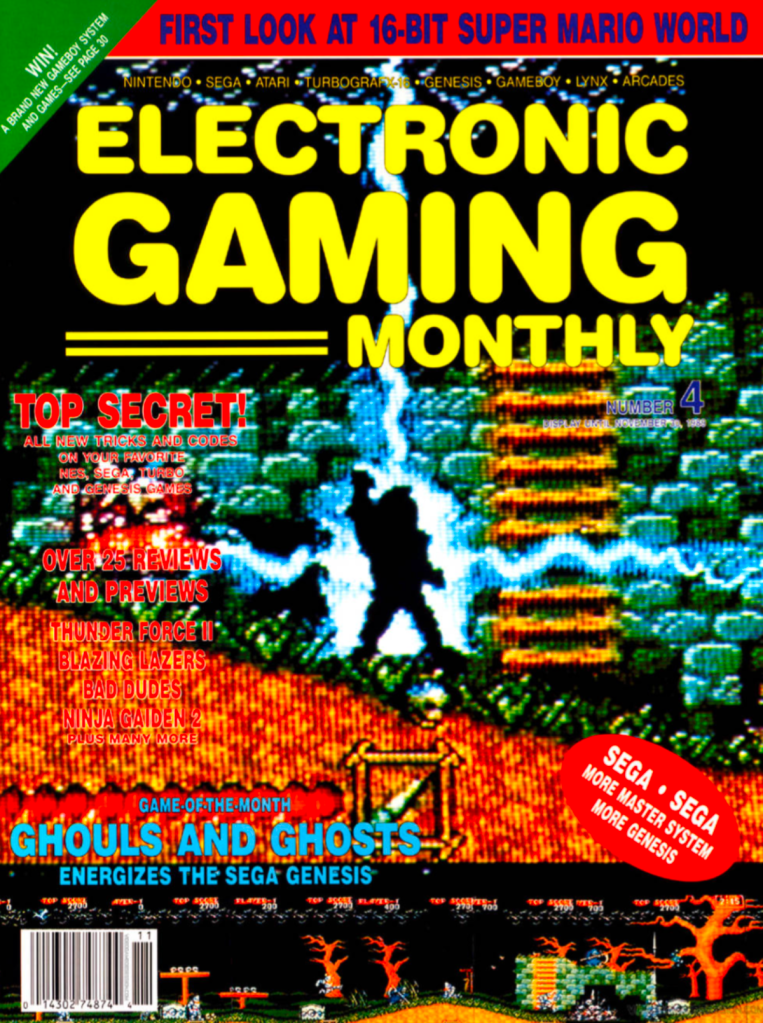
The next time you encounter a lightning-fast character or brace yourself for a merciless difficulty spike, remember Sir Arthur’s slow, arduous climb. Ghouls ‘n Ghosts was more than a technical miracle on a 5-Megabit cart, it was a massive salvo in the 16-bit console war and revealed, for the first time, that we had reached peak Nintendo. It was the convergence of Fujiwara’s vision, Capcom’s programming, and Sega’s determination. It proved that the home console could finally mirror the arcade experience, redefining consumer expectations forever and validating Sega’s aggressive vision and becoming the first must own cartridge of the 16-bit era.

 PlayZine
Leave a comment