The Dawn of Motion Controls
In the annals of retro gaming, there are a few artifacts that transcend mere hardware to become cultural touchstones. They represent an era’s boundless ambition, its technological dreams and its enduring legacy. With pixels pushing boundaries and chiptunes echoing through suburban homes, gaming was already a phenomenon, a vibrant new form of interactive entertainment that captivated millions. Just when we thought gaming couldn’t get any cooler, something truly revolutionary burst onto the scene, promising to transform our very interaction with virtual worlds. The legendary Power Glove wasn’t just a controller, it was your connection into another world.
Remember the whispers? The magazine ads bathed in an electric blue glow, featuring a kid who looked like he’d just stepped out of a sci-fi flick, sporting a gauntlet that seemed to hum with futuristic energy. “EVERYTHING ELSE IS CHILD’S PLAY,” the headline screamed. And boy, did we believe it. This wasn’t just a peripheral, this was the future. We were going to plug in, slip on this glorious piece of plastic and circuitry, and become one with our NES. No more fumbling with clunky controllers, no more cramped thumbs. This was a direct neural interface, or so we thought.
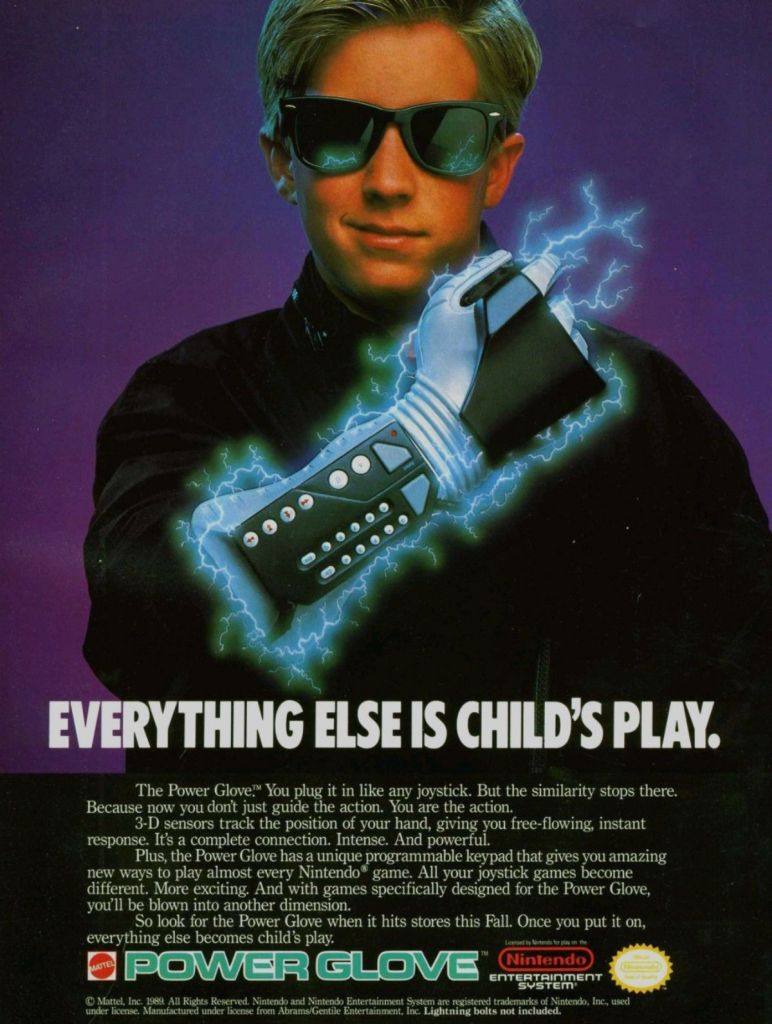
The hype, oh the glorious, unadulterated hype! Mattel, the titans of toys, teamed up with the marketing wizards at Nintendo to paint a picture so vivid, so utterly irresistible, that a whole generation of eager gamers practically salivated at the thought. Forget merely playing Mike Tyson’s Punch-Out!! – with the Power Glove, you were going to be going up against Mike Tyson, delivering pixelated uppercuts with a flick of your wrist. Rad Racer? You weren’t just pressing buttons, you were gripping an imaginary steering wheel, feeling the turns, pushing forward for speed, pulling back to brake. It was, according to the ads, “the cutting edge,” allowing you to “slip your hand into action” and achieve “free-flowing, instant response”.
So Bad it’s Good
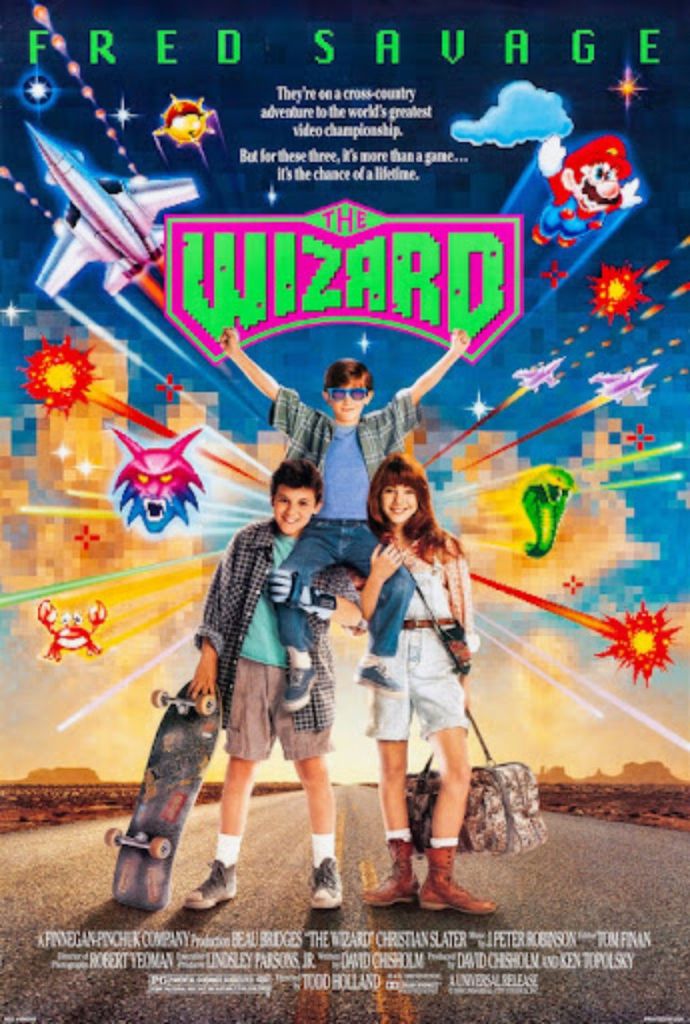
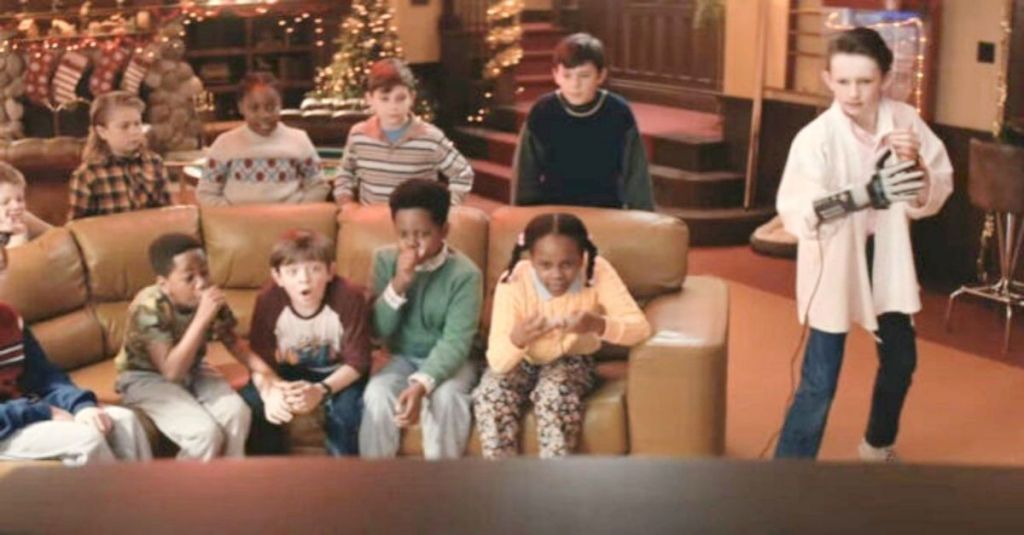
And then there was The Wizard. Ah, The Wizard. If there was ever a movie that perfectly encapsulated the late 80s zeitgeist, it was this blatant, glorious, utterly shameless Nintendo commercial disguised as a feature film. The cinematic debut of the Power Glove, just a couple of months after its real-world release, was a stroke of marketing genius. You had Fred Savage, you had cross-country adventures, you had video game competitions, and then… there he was. Lucas Barton. The smug, sunglasses-wearing prodigy, oozing confidence as he strapped on the Power Glove.
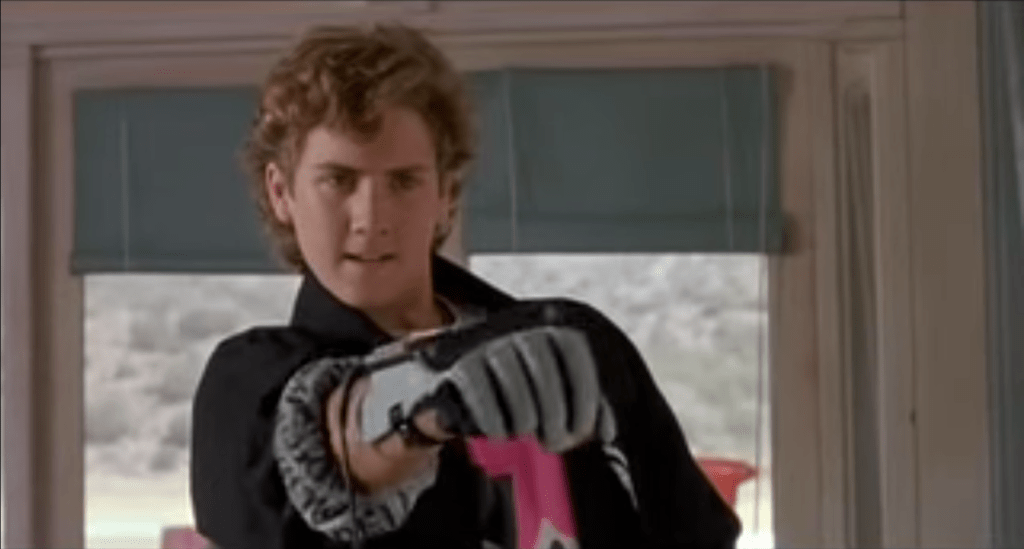
And then, the immortal line delivered with zero irony: “I love the Power Glove. It’s so bad.” Then watching him effortlessly dominate Rad Racer with mere gestures, our little gamer hearts swelled with anticipation. If he could do it, we could do it! The movie poster even had Fred Savage rocking the glove, albeit on his left hand, a version that was never made. The message was clear: this was the accessory of champions, the key to unlocking true gaming mastery.
First Impressions: A Sci-Fi Flop
Fast forward to Christmas morning, 1989. Or maybe a birthday. Or perhaps a desperate plea to parents that involved chores and promises of good behavior for the next decade. There it was: the sleek, black and gray gauntlet, looking like something ripped from a sci-fi movie. The box, adorned with that electric glow, practically hummed with potential. We tore it open, eyes wide with wonder. This was it. Our lives were about to change.
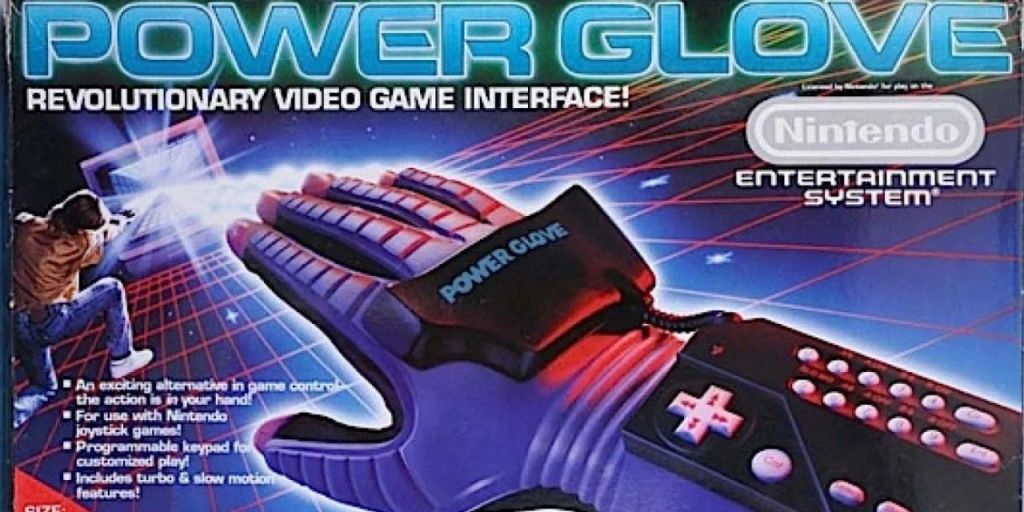
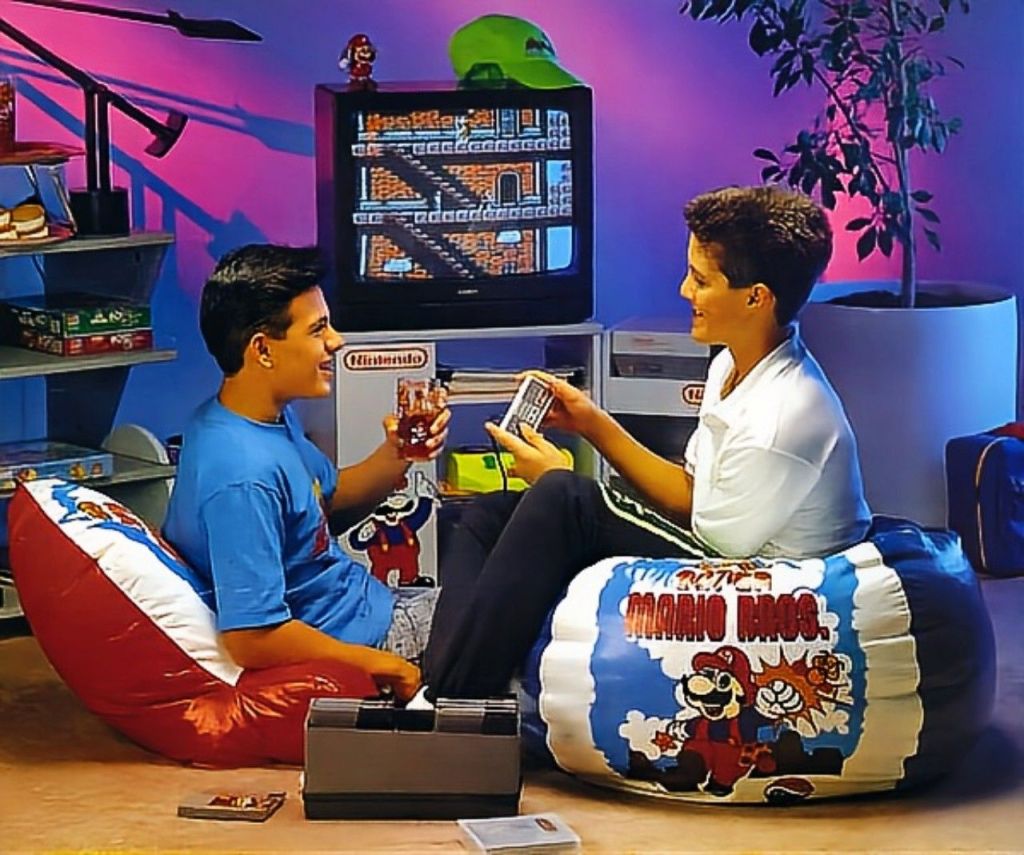
We plugged it in. We carefully arranged the ultrasonic receivers on top of the TV, trying to make sure they had a clear line of sight to our soon-to-be-omnipotent hand. We slipped on the glove, marveling at the fiber optic tubes woven into the fingers, imagining the intricate data streams flowing from our movements to the NES. We felt the weight of the traditional NES buttons on the forearm, a comforting familiarity amidst the futuristic design.
And then… we tried to play.
We were then faced with the immediate, soul-crushing realization that Lucas Barton was either a wizard, a liar, or an alien with superior motor skills. Because the Power Glove was not good. In fact, Lucas’s iconic line, taken literally, became a painfully accurate assessment: “It’s so bad.”
Let’s talk about precision, or rather, the glorious lack thereof. The promise was free-flowing, intuitive control. The reality was a chaotic dance of flailing limbs and frustrated grunts. Want to move right? The character might twitch erratically, perhaps take a hesitant step, or just stand there, mocking you with its pixelated inertia. Trying to punch in Mike Tyson’s Punch-Out!!? You’d swing your arm with all the conviction of a budding prizefighter, only for Little Mac to deliver a weak jab to thin air, leaving him wide open for a KO.
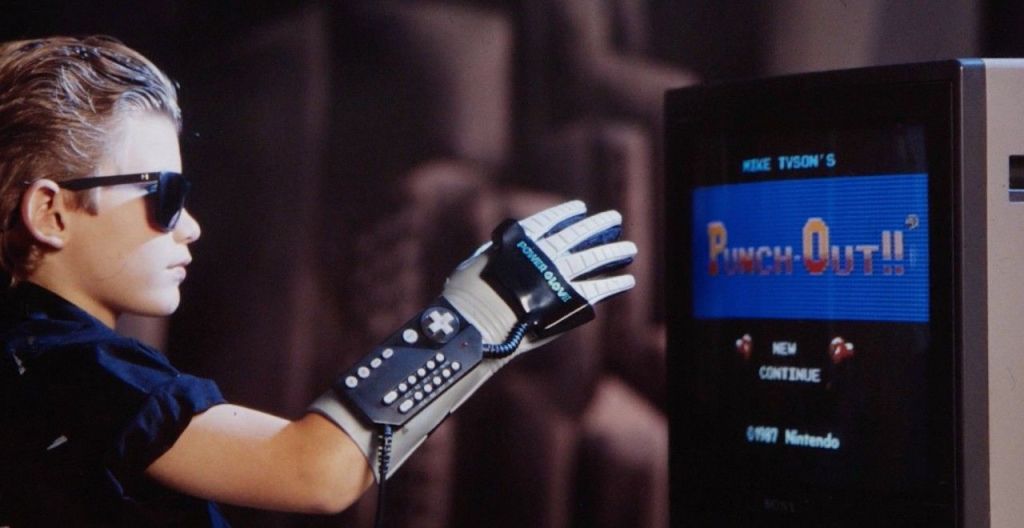
The calibration process alone was a trial in patience. Those ultrasonic sensors, meant to triangulate your hand’s position in 3D space, were notoriously finicky. A slight shift in your seating, a well-meaning pet wandering into the signal path, or even just a heavy sigh could throw everything off. You’d spend more time trying to get the glove to register your movements correctly than actually playing the game. It was a constant battle against an invisible enemy of technological imprecision.
And the games! Only two titles were specifically designed to leverage the Power Glove’s unique features: Super Glove Ball and Bad Street Brawler. Super Glove Ball was a faux-3D puzzle game that probably looked cool in concept, but was an absolute nightmare to control. Bad Street Brawler was a beat-’em-up where you were supposed to punch and kick with your actual movements.
The kicker? The Power Glove was completely impractical for almost every game on the console. Think about that for a second. The entire vast, glorious library of NES classics – Super Mario Bros., The Legend of Zelda, Metroid, Castlevania – none of them were enhanced by this futuristic marvel.
In fact, most were made actively worse. Imagine trying to navigate Hyrule with flailing arm gestures, or trying to time jumps in World 1-1 with a device that seemed to have a mind of its own. It was a recipe for controller-throwing frustration, even when the controller was on your hand.
The Hype Bubble Pops
So, despite selling nearly one million units (a testament to the power of marketing and The Wizard), the Power Glove was swiftly branded a commercial disappointment and a financial flop. It was discontinued after just one year. The dream of immersive, gesture-based gaming quickly devolved into a collective sigh of disappointment heard around the world. It was a classic case of over-promising and under-delivering.
But here’s the thing about lovable failures: they become legends. The Power Glove, despite its utter impracticality, has transcended its humble beginnings as a flawed peripheral. It’s a cherished piece of gaming history, a symbol of a time when ambition sometimes outstripped technological capability, and a constant source of nostalgic chuckles.
Today, the Power Glove isn’t collecting dust in forgotten attics, it’s commanding surprising prices on eBay, becoming a must-have for collectors. Why? Because it’s more than just a controller, it’s an icon. It represents the audacious spirit of innovation, the boundless optimism of the late 80s, and the enduring power of a catchy movie line.
And while it was undeniably “so bad” in its original function, its spirit lives on. Modern hackers and DIY enthusiasts have taken the Power Glove’s underlying components and repurposed them for incredible things. People are connecting them to modern VR systems for hand tracking, controlling robots, creating electronic music, and even building low-cost prosthetic arms. It was ahead of its time, and now, with modern advancements, its true potential can be unlocked. The Power Glove, the commercial flop, became a testament to the idea that sometimes, true innovation is just waiting for the technology to catch up.
So, the next time you see a Power Glove, whether in a retro game store, a dusty old box, or perhaps ironically displayed on a shelf, don’t just see a failed peripheral. See a dream. See a moment in gaming history where we dared to believe we could literally reach into our games. See the beginning of a conversation about motion control that would eventually lead to the Wii and Kinect. And remember Lucas Barton’s words, with a knowing wink: “I love the Power Glove. It’s so bad.” And sometimes, “so bad” is precisely what makes something so good.

 PlayZine
Leave a comment